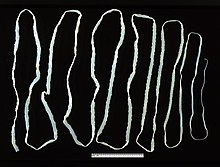
Eucestoda, commonly referred to as tapeworms, are the larger of the two subclasses of flatworms in the class Cestoda (the other subclass is Cestodaria). Larvae have six posterior hooks on the scolex (head), in contrast to the ten-hooked Cestodaria. All tapeworms are endoparasites of vertebrates, living in the digestive tract or related ducts. Examples are the pork tapeworm (Taenia solium) with a human definitive host, and pigs as the secondary host, and Moniezia expansa, the definitive hosts of which are ruminants.

Body structure
Life stages
Common infective species
Medical importance
Taeniasis
Taeniasis is an infection within the intestines by adult tapeworms belonging to the genus Taenia.[6][7] It is due to eating contaminated undercooked beef or pork.[6] There are generally no or only mild symptoms.[6] Symptoms may occasionally include weight loss or abdominal pain.[8] Segments of tapeworm may be seen in the stool.[8]
Cysticercosis
Cysticercosis is a tissue infection caused by the young form of the pork tapeworm.[9][10] Infection occurs through swallowing or antiperistaltic contractions during regurgitation carrying eggs or gravid proglottids to the stomach. At this point, larvae hatch when exposed to enzymes and penetrate the intestinal wall, travelling through the body through blood vessels to tissues like the brain, the eye, muscles, and the nervous system (called neurocysticercosis).[5]
At these sites, the parasites lodge and form cysts, a condition called cysticercosis, producing inflammatory reactions and clinical issues when they die, sometimes causing serious or fatal damage. In the eye, the parasites can cause visual loss, and infection of the spine and adjacent leptomeninges can cause paresthesias, pain, or paralysis.[11]
Echinococcosis (hydatid disease)

Humans become accidental hosts to worms of the genus Echinococcus, playing no role in the worm's biological cycle. This can result in echinococcosis, also called hydatid disease. Humans (usually children) become infected by direct contact with dogs and eating food contaminated with dog feces. Common sites of infection are the liver, the lungs, muscles, bones, kidneys, and the spleen.[12]
Eggs hatch in the gastrointestinal tract after the consumption of contaminated food, after which the larvae travel to the liver through portal circulation. Here, the larvae are trapped and usually develop into hydatid cysts. While the liver is the first filter for trapping them, the lungs act as the second filter site, trapping most of the larvae that are not trapped by the liver. Some larvae escape from the lungs to cause cysts in other tissues.[5]
When a larva becomes established in tissue, it develops into a "bladderworm" or "hydatid" and can cause various cancer-like cysts that may rupture and interact with nearby organs. Most cases are asymptomatic, and the mortality rate is low, but various complications from these interactions may lead to debilitating illness.
Hymenolepiasis
Arthropods are intermediate hosts of Hymenolepis nana, otherwise known as the "dwarf tapeworm," while humans are used as final hosts. Humans become infected and develop hymenolepiasis through eating infected arthropods, ingesting eggs in water inhabited by arthropods, or from dirty hands. This is a common and widespread intestinal worm.[5]
While light infections are usually asymptomatic, autoinfection through eating the eggs of worms in the intestines is possible, and it can lead to hyperinfection. Humans can also become hyperinfected through ingesting grain products contaminated by infected insects. Infections involving more than two thousand worms can cause many different gastrointestinal symptoms and allergic responses. Common symptoms include chronic urticaria, skin eruption, and phlyctenular keratoconjunctivitis.[13]
Diphyllobothriasis
Diphyllobothriasis is caused by infection with Diphyllobothrium latum (also known as the "broad tapeworm" or "fish tapeworm") and related species. Humans become infected by eating raw, undercooked, or marinated fish acting as a second intermediate or paratenic host harboring metacestodes or plerocercoid larvae.[14]
Clinical symptoms are due to the large size of the tapeworm, which often reaches a length exceeding 15 m (49 ft). The most common symptom is pernicious anemia, caused by the absorption of vitamin B12 by the worm.[5] Other symptoms include various intestinal issues, slight leukocytosis, and eosinophilia.
Sparganosis
Sparganosis is caused by the plerocercoid larvae of the tapeworm Spirometra. Humans become infected by drinking contaminated water, eating raw or poorly cooked infected flesh, or from using poultices of raw infected flesh (usually raw pork or snake) on skin or mucous membranes.[15]
The most common symptom is a painful, slowly growing nodule in the subcutaneous tissues, which may migrate. Infection in the eye area can cause pain, irritation, edema, and excess watering. When the orbital tissues become infected, the swelling can cause blindness. An infected bowel may become perforated. Brain infection can cause granulomas, hematomas, and abscesses.
Subdivisions
The evolutionary history of the Eucestoda has been studied using ribosomal RNA, mitochondrial and other DNA, and morphological analysis and continues to be revised. "Tetraphyllidea" is seen to be paraphyletic; "Pseudophyllidea" has been broken up into two orders, Bothriocephalidea and Diphyllobothriidea.[16][17][18] Hosts, whose phylogeny often mirrors that of the parasites (Fahrenholz's rule), are indicated in italics and parentheses, the life-cycle sequence (where known) shown by arrows as (intermediate host1 [→ intermediate host2 ] → definitive host). Alternatives, generally for different species within an order, are shown in square brackets.
| This article uses material from the Wikipedia article Metasyntactic variable, which is released under the Creative Commons Attribution-ShareAlike 3.0 Unported License |